2026-04-03

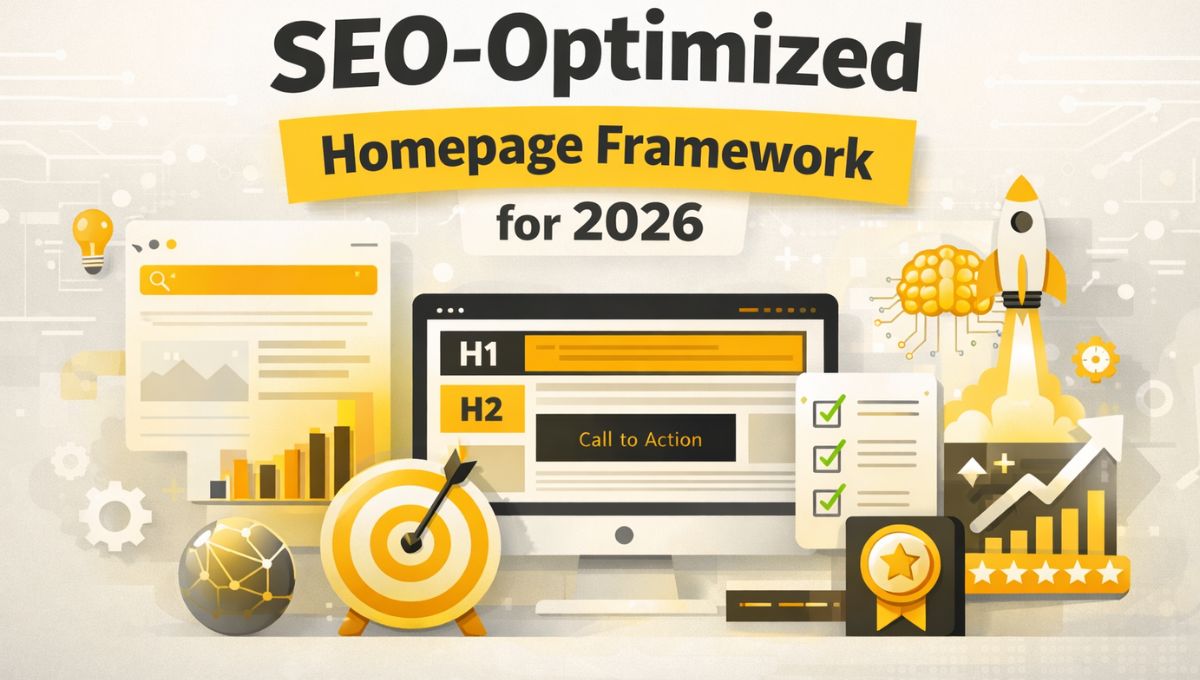
In 2026, the homepage is no longer just a branding page. It is the central SEO authority hub of a website. Search engines have shifted toward intent-driven ranking systems powered by AI, meaning structure, clarity, and contextual signals matter more than ever.
Modern algorithms used by platforms such as Google evaluate topical relationships, user behavior signals, and content architecture not just keywords. At the same time, AI systems developed by organizations like OpenAI are accelerating semantic search interpretation, making structured homepage design essential.
A strategically structured homepage improves crawl efficiency, strengthens domain authority, enhances user engagement, and increases conversion potential. Below is the most effective homepage framework for SEO success in 2026.
Your homepage must communicate its core value proposition immediately. Search engines now prioritize intent satisfaction over keyword frequency, so clarity is critical.
Above the fold, users and crawlers should instantly understand:
A strong homepage begins with one clearly defined H1 that reflects your primary offering. Supporting H2 and H3 headings should represent your main topical clusters, reinforcing semantic relationships. Avoid mixing unrelated services or industries on the homepage, as this weakens topical authority.
When your structure aligns with user intent, relevance scoring improves and search engines can confidently categorize your domain expertise.
The homepage carries the highest authority on your website. How it distributes internal links determines how efficiently search engines crawl and prioritize your pages.
In 2026, internal linking is no longer just navigation; it is authority signaling.
High-priority service pages and pillar content should be prominently linked from the homepage. Links should be grouped logically under thematic sections such as Services, Industries, or Resources. Important pages should be accessible within one to two clicks to maintain shallow click depth.
Excessive footer links or cluttered navigation dilute link equity and weaken structural clarity. A clean, hierarchical linking strategy improves indexation speed and reinforces topical relationships across the site.
Performance remains foundational to SEO.
With mobile-first indexing fully established, homepage performance directly influences rankings and engagement metrics. Core Web Vitals including Largest Contentful Paint (LCP), Cumulative Layout Shift (CLS), and Interaction to Next Paint (INP) measure load speed, visual stability, and responsiveness.
A performance-optimized homepage should:
Strong performance enhances user satisfaction, reduces bounce rates, and supports engagement signals that influence ranking stability.
AI-driven search experiences increasingly extract and synthesize structured information. To remain competitive, homepage content must be modular and machine-readable.
Large text blocks should be broken into concise, scannable sections. Clear headings, short paragraphs, and structured content blocks help AI systems interpret and categorize information accurately.
Adding structured data markup such as organization schema improves eligibility for enhanced search features and AI-generated summaries. This modular design strengthens your ability to appear in featured snippets.
Clarity is now both a user experience requirement and an AI optimization strategy.
SEO in 2026 is entity-driven. Search engines evaluate brands as defined entities within knowledge graphs.
Your homepage must clearly establish your brand identity, industry positioning, and expertise. This includes:
When your homepage reinforces consistent entity signals, search engines can confidently associate your brand with specific topics and industries. This strengthens trust and improves long-term ranking potential.
Authority must be structurally demonstrated, not implied.
SEO performance is no longer measured solely by traffic. It is measured by meaningful outcomes.
Your homepage layout should guide users toward primary actions while maintaining structural clarity for search engines. The ideal hierarchy includes:
Trust-building sections should precede major conversion prompts to reduce friction and improve engagement metrics. Alignment between SEO architecture and conversion design increases dwell time, interaction signals, and business ROI.
Accessible websites provide a better experience for all users and search engines recognize this.
Semantic HTML, proper heading hierarchy, descriptive ALT text, keyboard-friendly navigation, and readable typography all improve crawl clarity and usability.
Accessibility enhances engagement metrics, reduces usability barriers, and strengthens overall SEO performance. In competitive markets, inclusive design is both a compliance necessity and a ranking advantage.
Organizations that treat their homepage as a strategic SEO command center rather than just a visual brand showcase will achieve greater visibility, stronger engagement, and sustainable organic growth.
As search engines continue to evolve and AI systems refine content interpretation, homepage structure will remain one of the most powerful levers in modern SEO strategy.
At Tech Tales NZ, homepage optimization is approached as a strategic SEO foundation rather than just a design upgrade. We build structurally sound, intent-driven homepages that clearly define your topical authority, strengthen internal linking architecture, and align with modern AI-powered ranking systems. From semantic heading structures and entity optimization to crawl efficiency and structured data implementation, every element is engineered to help search engines accurately understand, categorize, and rank your brand.Our team integrates technical SEO, performance optimization, and conversion-focused UX into a unified growth framework. By improving Core Web Vitals, reinforcing brand authority signals, and designing modular content blocks for AI readability, we ensure your homepage functions as a high-performing organic growth engine. Whether you are targeting global markets or competitive regional terms like Seo Services in Delhi, Tech Tales NZ delivers structured, scalable strategies built for long-term ranking stability and measurable business impact.
Palvinder Singh is an SEO professional with 8+ years of experience scaling organic search performance, improving brand visibility, and driving measurable business results across competitive digital landscapes. He has a proven track record of boosting organic traffic, keyword visibility, and revenue for leading automobile brands, as well as delivering strong organic sales and conversions across both B2B and B2C e-commerce through performance-led SEO strategies.