2026-04-03

Your potential customer searched for a solution today. They didn’t visit your website. They asked an AI and it recommended your competitor.
This isn’t a prediction. It’s already happening.
In 2026, AI systems like Google’s AI Mode, AI Overview ChatGPT, Gemini, and Perplexity have fundamentally changed where brand discovery begins. Even if your website is ranking on the top, AI overview will acquire the real estate above your website and push down the traditional search results.
For a decade, the rules were simple: rank high on Google, drive traffic, convert visitors. That playbook is now obsolete. Now your client is more concerned about whether my brand is mentioned in AI or not?
This article breaks down exactly how brand discovery has shifted, what AI systems are prioritising, and what your business needs to do right now to stay visible in an AI-first world.
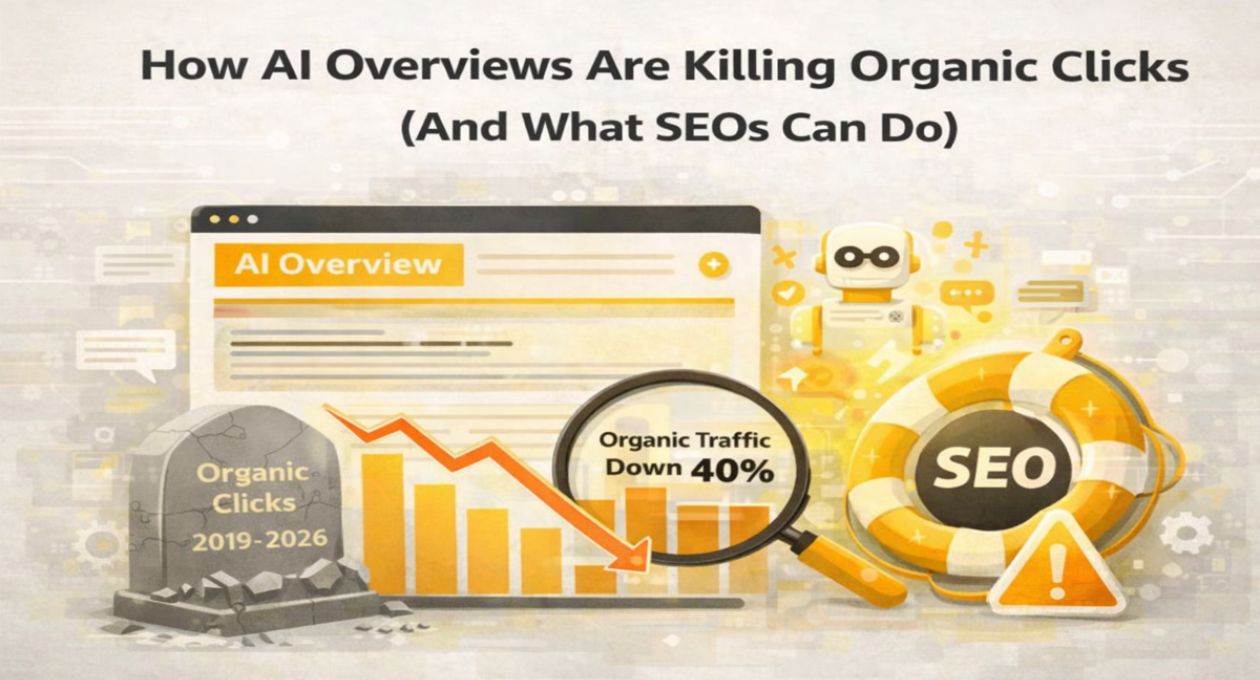
A new report from Ahrefs reveals that AI overviews are reducing click-through rate by 58%, even for the #1 ranking links.
While the traditional searching behaviour required users to filter out information, compare options, and make interpretations, AI has now unified these steps into a single interaction for users.
The main reason for this change is trust. Large Language Models (LLMs) like ChatGPT and Gemini are reducing time and efforts, and users are increasingly willing to trust AI-generated information. In fact, studies have found that more than 65% of users prefer AI-generated information while researching unfamiliar topics, as these tools simplify complex information for users.
For brands, this implies that earning visibility isn’t just about outranking competitors, but being mentioned in AI responses. Instead of just keywords, they’re being asked to optimize for context.
Organic clicks are steadily decreasing as zero-click searches become increasingly prevalent. With AI Overviews and search snippets, users get summarized results that eliminate the need for further exploration, thereby avoiding a website altogether.
Now this has a negative impact on SEO. Clicks decrease, and traffic for informational searches becomes increasingly difficult to achieve.
The way people are searching has also become more natural and conversational. Rather than a string of fragmented keywords such as “best budget car 2026.”, the question has turned into “What’s the best budget car for off-road travel?”
So, natural language optimization is becoming even more crucial. Since LLMs are proficient in structuring sentences and mirroring tone, they’re more relied on.
Long-tail keywords are also becoming more relevant in this context. They are more descriptive, more intention-based, and more likely to generate responses where brands are likely to be mentioned as recommendations.
Topical authority is when you’re established as a trusted source for a topic or related topics in your industry. This is earned by creating pillar pages and cluster content that signal to LLMs and search engines that you’re not just providing surface level information, but have in-depth insights for every stage of the users’ journey.
Topical authority also adds to credibility, which is yet another positive signal that LLMs pick up to reference your brand. Since LLMs don’t rank individual pages and focus on consistency in terms of expertise, building topical authority helps you gain visibility on AI systems.
While the argument remains that you need quality backlinks, they’re no longer the sole indicator of authority. The frequency and sources of your past brand mentions are also taken into account by LLMs.
Off-page branding such as PR, citations, forums, reviews, podcasts, etc. help you build the reputation you need to be featured in AI responses. Thus, focus has thus shifted from link building to reputation building. AI models are more interested in seeing who else talks about your brand and what its perception is in the market.
Search results on LLMs are never the exact same for two people. They provide responses that are specific to the individual, depending on the behaviour, preferences, location, and intent.
Hence, the discovery process becomes highly personalized. And for brands, it isn’t enough to be present in one place. They need to be cited and mentioned on different platforms in order to be discovered.
AI is changing how we see accessibility in the search journey. With more visual and voice-centric AI systems, image recognition and voice response generation is helping provide information to visually impaired individuals.
So, it’s not just the text content that has to be optimized in order to rank on LLMs. For images-based discovery, optimized images are a priority. At the same time, voice-centric searches are triggered on concise answers through structured data (Schema Markup) and FAQs. Cl
LLMs require clarity and structure in order for them to parse and interpret the content well. Content that’s well-structured has a higher chance of being understood and referenced.
Schema markups have shown significant importance in helping AI systems interpret the context, relationships, and intent of the content. Ultimately, the content must serve two purposes at once. It must provide an engaging and insightful experience to human users while also being easy for LLMs to parse, extract, and present responses.
How Brands Should Adapt Their SEO Strategy
It’s time to scrap the old marketing playbook and start optimizing for AI systems as well as search engines for optimal brand discovery:
AI systems focus on credible sources. Work on your experience, establish your expertise, build your authority through mentions, and maintain trust by delivering accurate and transparent content on different platforms. Case studies and testimonials can help you in gaining trust and reinforcing your expertise.
Choose the core topics most relevant to your business and commit to owning them completely. Build pillar pages that provide authoritative overviews, then surround them with cluster content that addresses every sub-topic, question, and use case your audience might have. Depth and consistency over time is what builds the topical authority that AI systems recognise.
Brand discovery on LLMs happens across multiple platforms. To ensure your presence on LLMs and search engines, you can experiment with different content formats, and repurpose it for different platforms, such as LinkedIn, gated ebooks, or blogs. This way your team won’t need to create fresh content every time when you can optimize what’s already working.
Audit your existing content and identify opportunities to incorporate natural language questions and answers. Add FAQ sections to key pages, use conversational subheadings, and write in the way your audience actually speaks when seeking information. This directly improves your chances of being extracted and referenced in AI-generated responses.
Ensure schema markup is implemented across your key pages, particularly service pages, FAQ sections, and articles. At a minimum, implement FAQPage, Article, LocalBusiness, and Organisation schema where relevant. This is one of the most direct technical signals you can send to AI systems about the nature and credibility of your content.
Bottom Line
We’re at the cusp of a major digital reform and it’s already changed how we find something online. Whether it’s a viral sunscreen or a complex B2B SaaS product, people have switched to AI for specific answers. This is shaking the long-term foundation of brand discovery from search engine rankings to AI recommendations.
This has significant implications for businesses. Those who embrace AI-driven SEO early on will reap the benefits, while others risk lack of visibility in the AI-led discovery process.
At The Tech Tales, SEO Company in India, we assist brands in overcoming challenges related to AI discovery. Our team focuses on making you a credible source in AI-generated responses by making a personalized strategy that includes strengthening your topical authority and improving your brand presence across different platforms. If your brand isn’t showing up on LLMs yet, we can help. Get your free digital presence audit on a 30-minute call.
Palvinder Singh is an SEO professional with 8+ years of experience scaling organic search performance, improving brand visibility, and driving measurable business results across competitive digital landscapes. He has a proven track record of boosting organic traffic, keyword visibility, and revenue for leading automobile brands, as well as delivering strong organic sales and conversions across both B2B and B2C e-commerce through performance-led SEO strategies.
AI is shifting brand discovery from traditional search engines to answer engines. Instead of browsing multiple websites, users now rely on AI-generated responses from platforms like ChatGPT, Gemini, and Google AI Overview, which directly recommend brands within their answers.
Organic clicks are declining due to the rise of zero-click searches. AI-generated summaries and overviews provide users with instant answers, reducing the need to visit websites, even for top-ranking pages.
In AI-driven search, brand mentions across platforms like PR articles, forums, reviews, and podcasts are becoming as important as backlinks. AI models analyze how often and where your brand is referenced to determine credibility and relevance.
Businesses should focus on natural language content by incorporating question-based headings, FAQs, and long-tail keywords. Writing content that mirrors how users speak improves the chances of being featured in AI-generated responses.
Structured data (schema markup) helps AI systems better understand your content’s context and intent. Implementing schemas like FAQPage, Article, and Organization increases the likelihood of your content being extracted and displayed in AI answers.
Brands should focus on building topical authority, strengthening E-E-A-T (Experience, Expertise, Authority, Trust), increasing multi-platform visibility, and optimizing content for AI systems alongside traditional search engines.